Knife Basics: Dice, Julienne & Chiffonade
As an Amazon Associate I earn from qualifying purchases. We may also earn from Viator and GetYourGuide bookings. Disclosure
Grip and stance
Pinch the blade just in front of the handle between your thumb and the side of your index finger, with your other fingers wrapped around the handle. This 'pinch grip' gives far more control than holding the handle alone. Stand square to the board, which should sit on a damp cloth so it can't slide.
Your guiding hand forms a claw: fingertips tucked under, knuckles forward. The flat of the blade rides against your knuckles, so the edge never meets your fingertips.
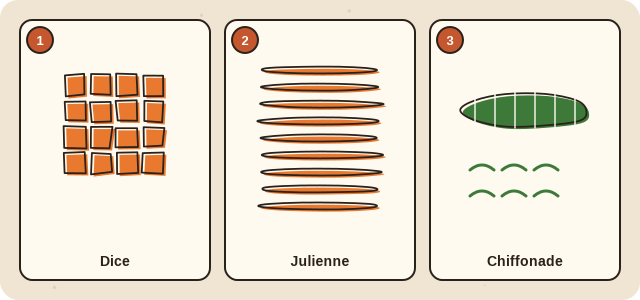
Dice
Square off the vegetable, cut it into planks of the thickness you want, stack the planks and cut into sticks, then cut across the sticks into cubes. Sizes used in recipes: brunoise about 3 mm (⅛ in), small dice 6 mm (¼ in, as in picadillo de papa), medium dice 12 mm (½ in).
For onions, halve through the root, peel, make horizontal and vertical cuts toward (not through) the root, then slice across.
Julienne
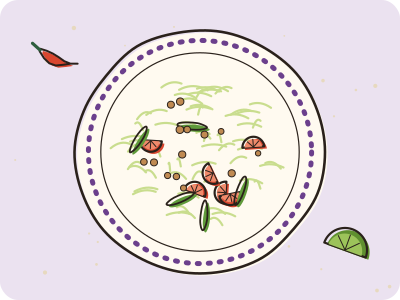
Matchsticks about 3 mm thick and 5–6 cm long. Cut planks 3 mm thick, stack, and slice into 3 mm sticks. For som tam, a julienne peeler is faster than a knife for green papaya, or use the Thai method: hack shallow lengthwise cuts into the peeled papaya, then shave off the strands.
Chiffonade
Fine ribbons of leafy herbs. Stack basil or other large leaves, roll them tightly like a cigar, and slice across with a sharp knife in one smooth stroke per cut. A dull knife bruises the leaves and they darken quickly.
Keeping it safe
A sharp knife is safer than a dull one because it needs less force. Wipe the blade toward the spine, never along the edge, and don't leave knives in a sink of soapy water.
Chosen from product listings that match this guide. Details are paraphrased from each listing; WorldCooks hasn't used these items in a test log.